Episode 16 · 6 Sep 2026 · 31:15
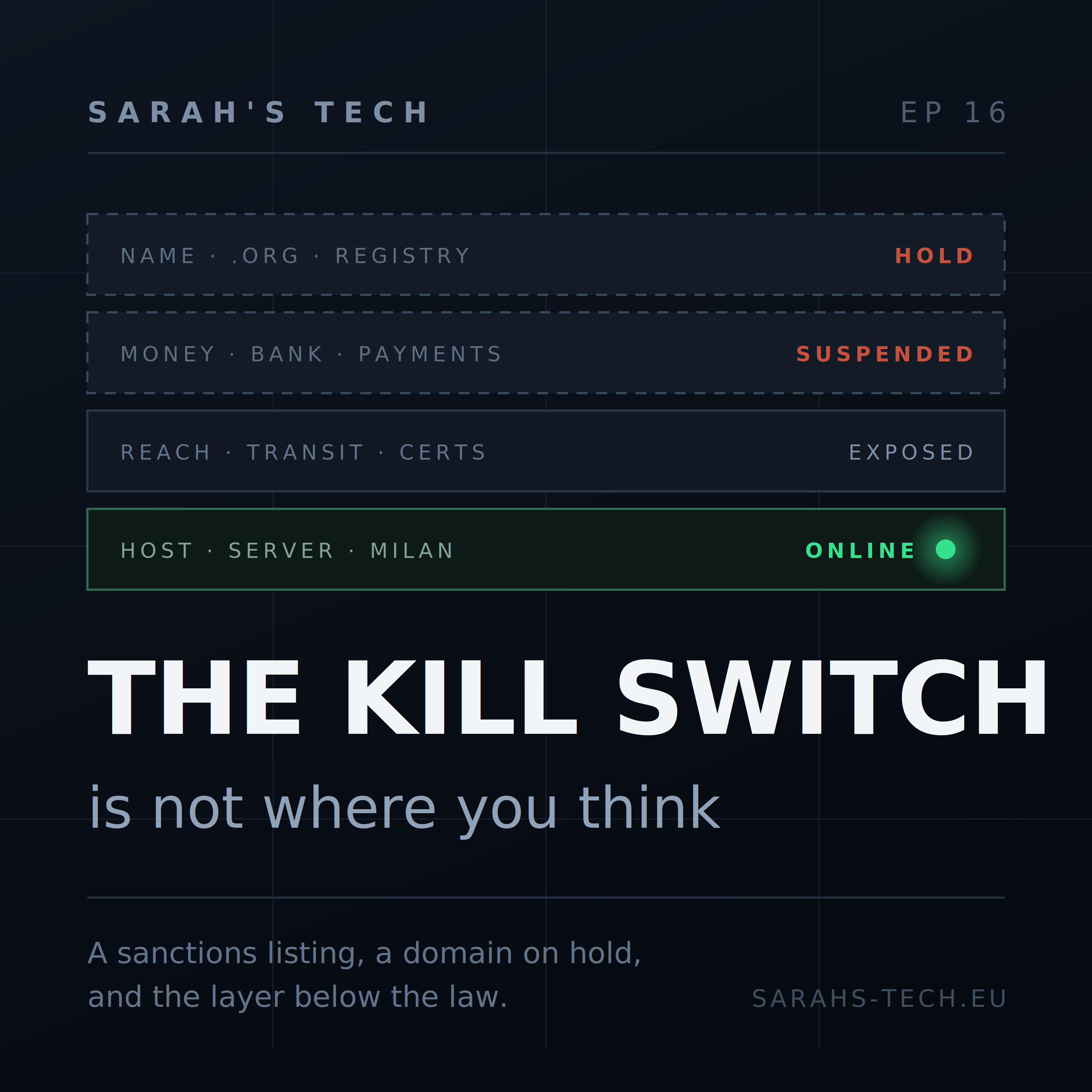
The Kill Switch Is Not Where You Think | A Sanctions Listing, a Domain on Hold, and the Layer Below the Law
The server in Italy stayed powered on the whole time. The name went dark, then the bank account went. Neither needed a court.
Show notes and chapters
A server in Italy stayed powered on the whole time, and the website on it vanished anyway. This episode follows what actually broke — the name first, then the money — and why a European hoster's liability privilege was worthless the moment pressure arrived from underneath it.
In this episode:
- Cold Talk & Housekeeping. The December deadline for machine-readable marking under Article 50(2), Nvidia's roughly $13bn Hugging Face agreement as an answer to last episode's ROI question, and the date the imaginary ETF basket was fixed.
- The Server Is Fine. Powered on, unreachable. Nothing on the machine failed.
- What Actually Happened. The 26 August SDGT designation under EO 13224, the allegations, the denial, why a sanctions listing is not an FTO designation, plus the wind-down clock.
- Anatomy of a Shutdown. Four layers: name, money, reach, certificates. The .org registry sits under US contracts, and an Italian bank suspended an Italian account over secondary sanctions risk. Who set the domain hold stays open, because it is.
- Two Legal Orders, One Server. The DSA privilege assumes notice, response, eventually a court. A designation is an executive determination. The collective still holds the privilege — it is simply worthless.
- What If We Just Said "No"? Article 48 GDPR says refusing a US data demand is correct. E-Evidence gives European prosecutors ten days, or eight hours in emergencies. No equivalent exists across the Atlantic.
- The Case Against Me. Sarah's rebuttal: an extreme case, diversification that manufactures fragility, and infrastructure that cannot be switched off for bad reasons cannot be switched off for good ones.
- What To Take Away. Draw the real map, know which link goes first, make the cheap changes not the dramatic ones.
- Outro Song. "Europe On The Wire" (Eurodance mix) — like the host, mainly synthetic.
Key Takeaways:
- Hosting Is the Last Layer, Not the First: The name went first, the bank account second. Server location was never the exposed part.
- Sanctions Work Through Third Parties: Make staying riskier than leaving and everyone leaves unprompted — including a bank that objected publicly while doing it.
- The Privilege Assumes a Procedure: Europe established that a hoster is not the judge of its users. It never addressed the hoster as defendant, without a trial.
- The Difference Is Reach, Not Rigour: The EU terror list is a Council decision, not a court ruling. But an EU listing cannot take an American host offline. The reverse works.
Sources (links at sarahs-tech.eu): the Treasury and State Department announcements of 26 August 2026, OFAC General Licence 36, the collective's response, Banca Etica's statement of 1 September, DSA Articles 4–9, Article 48 GDPR, Regulation (EU) 2023/1543, AI Act Article 50.
Disclosure: Sarah Vailby is a synthetic host, AI-generated and disclosed in every episode under the AI Act's transparency rules. Markus works in web hosting; nothing here reflects an employer's position. Neither host has seen the evidence behind the designation, and both the allegations and the origin of the domain hold are left unresolved on purpose.
Feedback: Draw your own map. Which top-level domain, which registrar, which payment provider, which certificate authority — and how many answer to a jurisdiction you did not choose? Has anyone changed a supplier over this, or is it a slide? Write to feedback@experten-system.de.